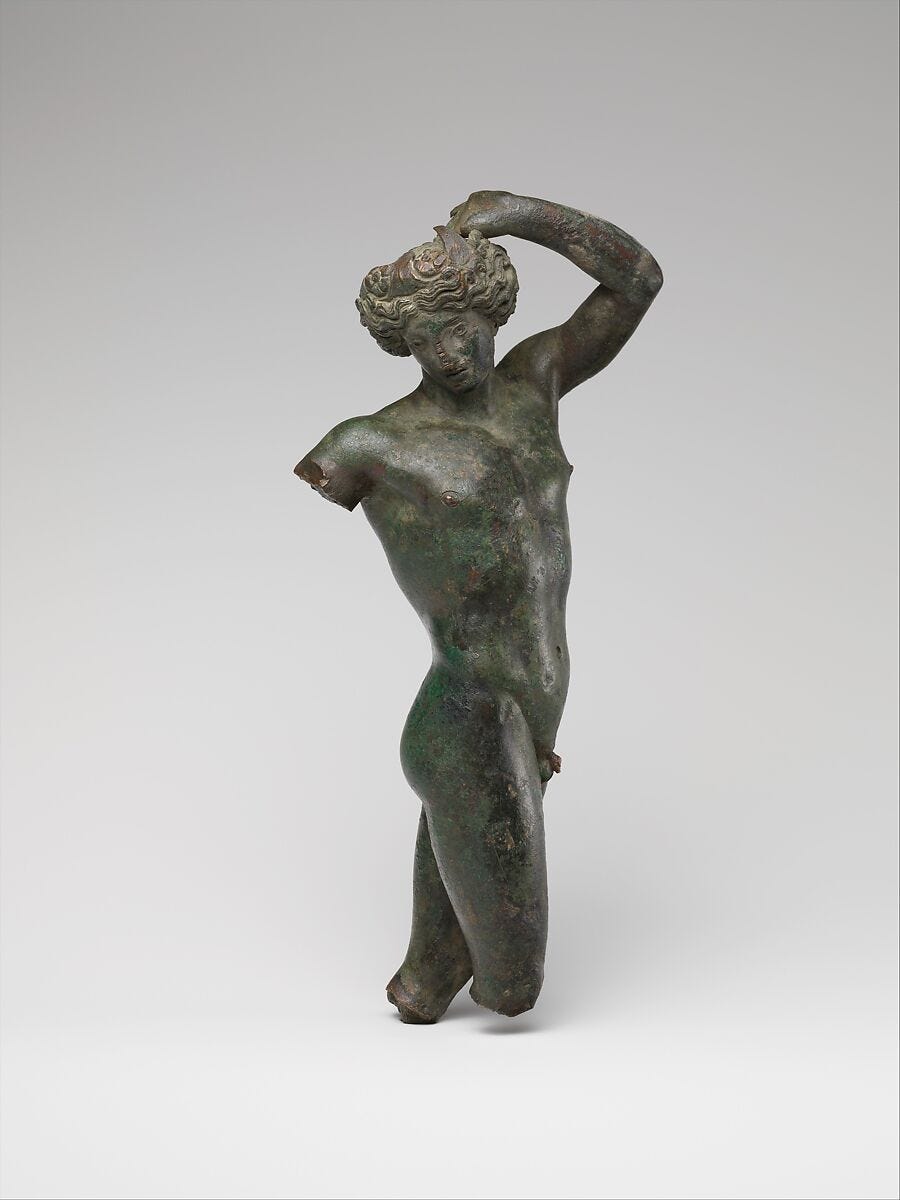
Contrapposto
By Stewart Burke
One posture pleases most in death or love,
that blithe angle of artless poise rejoiced
when troops of angels by fulcrum hoist
one ilium as if by wings of a dove.
Like the grey undersides of late Spring leaves,
the merest dip in space and time reveals
an elegant bearing which balms and heals—
or brings to ardent souls quickening heaves.
Radha beguiled Lord Krishna with such sways;
Aphrodite rose from a veinous shell,
borne upon the green sea foam’s gull-skipped swells,
shy as Donatello’s David’s lower’d gaze;
Buonarotti’s Laocoon fought snakes aslant;
Saint Sebastien, skewered, hips askew:
death’s last indignity Mantegna drew;
the Three Grace’s glabrous Canovan cant.
In jewel-strapped gown, thumb sur-la-table pressed,
John Singer Sargent’s Madame X’s fair
satin silhouette limned her sex’s air
in a manner sublimely auburn-tressed.
Fei’s Jinling Beauties Twelve, sinuous,
by moon windows and rosewood casements framed,
each belle by flower known, by hairpin named:
a king must smile to seem them posing thus.
Confident girl, bemused, swirling bun
On shoulder rests. Mohenjo Daro’s brood,
Gracile, bangled arm akimbo, nude;
A votive dancer, a gift to the Sun.
The arc of declination, most to least,
the gulled-in waist-to-hip ratio:
even in death Fuseli’s Dido
lures amorous eyes to a final feast.
Discover more of Stewart’s poetry.
The Garden of Lonely Pleasure, Silver Salver, Golden Chalice & Hope Is an Encrusted Anchor
Featured in New Lyre Summer 2023. Paid subscribers can download the full issue at the bottom of this page.
New Lyre Podcast #34: Contrappostos, Mughals, and the Miracle of Art
Poet Stewart Burke joins us to discuss the miraculous process of making art and the role of the poem as teacher. From Ancient Greek sculpture to the Mughal Empire, we discuss some of the historical sources behind his own creative enthusiasm.
New Lyre Magazine Archive
Click on the cover of any issue to order New Lyre Magazine directly from Amazon. Subscribers can access the full archive at the bottom of this page.


"The truly great must disdain posthumous fame" is a quote I find agreeable. Maybe its author meant honesty was their preference and knew that "veritas odium parit."
Another I like is "The pest of society is egotists."
Just one more: "No picture of life can have any veracity that doesn't admit the odious facts."
Just dreaming in the wings. Must get back to American transcendentalism.
To add a remark, the poem's style is what comes through to me most. Its theme is more elusive I found. The style struck me as good, but I'd need to reread it before I could be certain. I can admire style, but only from afar, since "art" in writing isn't my first concern. So I'll reread it.
The most interesting writing, to me, speaks plainly and clearly. Just noting my own taste. I'm not a believer in art for art's sake. I give primacy in my own effusions to speaking my mind as clearly as I can about matters I regard as most important.
The poem shows above-average command of the lingo. One line reminded me of Stevens, the last line of one of his stanzas, which line is a string of quite uncommon words. Was "fisc" one of them?
Anyway, you will follow your own lights.