Three Poems by Gabriele D'Annunzio
Translation
A Genre Picture
The evening’s mild: darlings
play, singing under the balconies;
in the bars, headlong on wings,
toasts and good bottles pop in volleys;
and off like many a sparrow
laughing children go.
The evening’s mild: the beat
bounces, flying from hearts that are glad;
to the sound of cymbals in the street,
tawny gypsies, all flower-clad,
in the candid, new moon’s aura
hop, dancing the tarantella.
The Stag
Do you not hear the dark roar drifting through
the sweep of the Serchio? The black-hoofed stag
separates from the herd, from the females,
and slips off to the wild. Soon he will sleep
upon a green bed, bowered in thick brush,
snuffling off from his frizzy snout a breath
with a violence—with a slight whiff of mint.
The tracks he leaves below have an odd look,
you know? like a pureblooded heart leaping.
Following that form he stamps the fat earth;
and the stamped clods of dirt, that he lifts up
with each of his hooves, he then lets drop down.
Well, this, what’s called, “the great seal,” the wary
hunter finds legible, reading therein
certain signs; and his judgement never fails,
oh, blessed one, who, a head of great blood,
pursues upon the setting of the stars,
and kills upon the rising of the sun,
and who sees the shudder of the vast corpse
being bit by dogs and the high antlers
of its brow rattle at end of quarrel!
But in vain, in vain we hear the dark roar
as we rest in-between the river-reeds.
You will not slip in the Serchio to swim
to chase his trail, O Derbe; and the brisk
river will not line the lineaments
of your legs and your merciless laughter,
the fierce writhing of your flesh in the cold.
We’re unarmed and enrapt in your beauty,
stoop low and discover how our hearts roar,
farther than even the roar of the stag,
with the primordial passion for prey.
Now he wends from the herd and to the wild.
Perhaps he’s of famed loins, from many lines.
He no longer knocks with his new antlers
the bark. Already his crown has grown hard;
and his neck has become dark and bearded,
and soon will be all swollen with many
a roar. At nightfall we will hear his long
moaning, and we will make out his bull’s voice;
the rising ululation of his lust,
we’ll mark in the silences of the moon.
A Memory
She kept her eyes fixed on the ground.
And the strange, silent minutes that passed
held, it seemed, voids severally profound.
Oh, if forever—by some surprise
thrust, we were made silent to the last!
But to her face, I slowly drew my eyes.
And still her pale lips, convulsing, I see.
The few words, which came at first,
were like drops of blood falling
from a sore just beginning to burst.
Quadretto di genere
La sera è placida: gl’innamorati
suonano cantano sotto i balconi;
dentro le bettole fieri ed alati
sprizzano i brindisi a i vini buoni;
via come passeri in compagnia
ridono corrono i bimbi via.
La sera è placida: le canzonette
balzano volano dai lieti cuori;
a ’l suon de’ cimbali ne le stradette
le brune zingare cinte di fiori
sotto la candida luna novella
saltano ballano la tarantella.
Il cervo
Non odi cupi bràmiti interrotti
di là del Serchio? Il cervo d’unghia nera
si sépara dal branco delle femmine
e si rinselva. Dormirà fra breve
nel letto verde, entro la macchia folta,
soffiando dalle crespe froge il fiato
violento che di mentastro odora.
Le vestigia ch’ei lascia hanno la forma,
sai tu?, del cor purpureo balzante.
Ei di tal forma stampa il terren grasso;
e la stampata zolla, ch’ei solleva
con ciascun piede, lascia poi cadere.|
Ben questa chiama “gran sigillo„ il cauto
cacciatore che lèggevi per entro
i segni; e mai giudizio non gli falla,
oh beato che capo di gran sangue
persegue al tramontare delle stelle,
e l’uccide in sul nascere del sole,
e vede palpitare il vasto corpo
azzannato dai cani e gli alti palchi
della fronte agitar l’estrema lite!
Ma invano invano udiamo i cupi bràmiti
noi tra le canne fluviali assisi.
Tu non ti scaglierai nel Serchio a nuoto
per seguitar la pesta, o Derbe; e il freddo
fiume non solcherà suplice solco
del tuo braccio e del tuo predace riso,
fieri guizzando i muscoli nel gelo.
Inermi siamo e sazii di bellezza,
chini a spiare il cuor nostro ove rugge,
più lontano che il bràmito del cervo,
l’antico desiderio delle prede.
Or lascia quello il branco e si rinselva.
Forse è d’insigni lombi, e assai ramoso.
Ei più non vessa col nascente corno
le scorze. Già la sua corona è dura;
e il suo collo s’infosca e mette barba,
e fra breve sarà gonfio dal molto
bramire. Udremo a notte le sue lunghe
muglia, udremo la voce sua di toro;
sorgere il grido della sua lussuria
udremo nei silenzii della Luna.
Un ricordo
Ella teneva a terra gli occhi fissi.
Nel silenzio incredibile i minuti
pareano aprire smisurati abissi.
Oh se per sempre, sotto un improvviso
colpo, fossimo noi rimasti muti!
Lenta mi sollevò quelli occhi al viso.
Ancora la convulsa bocca esangue vedo.
Le prime sue parole, rare,
cadono come gocciole di sangue
da piaga che incominci a sanguinare.
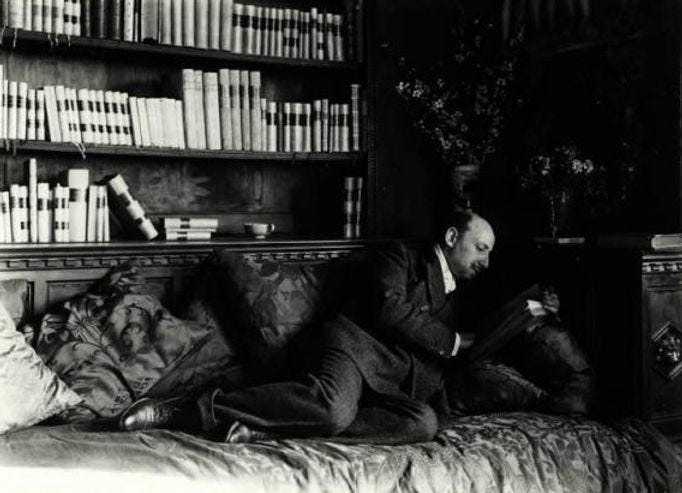
Image in Public Domain by Mario Nunes Vais
Michael Shindler is a writer living in Washington, DC. His work has been published in outlets including The American Spectator, The American Conservative, Church Life, University Bookman, North American Anglican and New English Review. Follow him on Twitter: @MichaelShindler.


Very adept translations of an unjustly reviled poet who I think is finally coming into his proper place
The second brought to mind some of Homer's Adirondack watercolors. Hunters would beat drums to drive deer towards a nearby pond or river. The deer would leap into the water and swim for their lives. Canoes had been placed in advance on the shore by the hunters, for the purpose of pursuit. They slid them into the water and rowed, & when they caught up with a fleeing deer, would bash its head with an oar and kill it. Rather grisly to say the least. That's my memory anyway of how deer-hunting was done in The Adirondacks back then(19th cent.)